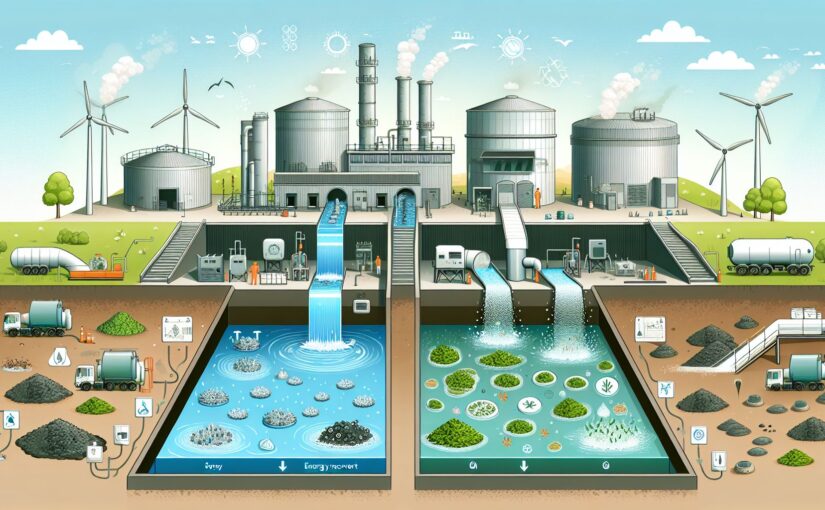
Wastewater treatment is an essential public health service that has historically been associated with high energy consumption and significant environmental impact. However, the advent of innovative bioelectrochemical systems is revolutionizing how we approach wastewater management. Among these, Microbial Fuel Cells (MFCs) have emerged as a particularly promising technology, capable not only of purifying water but also of generating electricity – transforming waste into wealth.
What Are Microbial Fuel Cells?
Microbial Fuel Cells are bioelectrochemical systems that harness the power of microorganisms to convert organic matter into electrical energy. At their core is a simple yet profound process: bacteria consume organic substrates found in wastewater and release electrons as they metabolize the energy within these compounds. These electrons, rather than dissipating as heat in conventional biological processes, are captured and directed through an external circuit as electrical current. The result is a novel way to extract value from waste — in the form of clean water and bioelectricity.
The Mechanics of MFCs for Wastewater Treatment
The core components of an MFC are the anode, the cathode, and the often-employed proton exchange membrane (PEM) separating them. The anode is the domain of electroactive bacteria, the engine room where organic waste is broken down and electrons are released. These bacteria are often referred to as exoelectrogens for their ability to transfer electrons outwardly to an electrode. Among the various types present in wastewater, Shewanella and Geobacter species are notable for their anode-respiring capabilities.
At the anode, substrates in the wastewater undergo degradation as the electroactive bacteria feed. This process, mediated either with or without exogenous chemical mediators, leads to the release of protons and electrons. Mediator-less, or direct electron transfer (DET), systems are generally regarded as more sustainable and cost-effective due to the omission of chemical intermediaries which can complicate the process and raise costs.
While electrons journey through the external circuit powering electrical devices, the protons migrate through the PEM to the cathode. Here, the protons, electrons, and oxygen from air or other oxidants engage in a reduction reaction, forming water or other benign compounds. The flow of electrons from anode to cathode constitutes the electrical current harnessed by the MFC.
Energy Outcomes and Efficiency
The power density and Coulombic efficiency are crucial metrics in assessing an MFC’s performance. Power density reflects the electrical power output per volume or area of the MFC, and high values are often pursued for practical applications. Coulombic efficiency shows how effectively the electrons resulting from substrate degradation are converted into electrical current. Although these values can vary widely depending on the design and operational conditions of the MFC, optimizing both is essential for the system’s overall efficacy and commercial viability.
Advances in MFC Technology
Material science has been at the forefront of improving MFC performance. Electrode materials, in particular, have received a lot of attention. Carbon-based electrodes offer high electrical conductivity and surface areas conducive to bacterial colonization, rendering them popular choices. Furthermore, advances in catalyst-coated electrodes have shown promise in enhancing electron transfer and reducing activation losses within the cells.
Another crucial factor has been the system’s design and scalability. While laboratory-scale MFCs have demonstrated the concept’s validity, scaling up to industrial sizes poses significant challenges. Stacked and continuous flow MFCs have been proposed to address the need for larger treatment capacities while maintaining high treatment efficiencies. Additionally, innovations like sediment MFCs and Plant-Microbial Fuel Cells open up possibilities for in-situ energy recovery in natural and agricultural settings, while microbial electrolysis cells provide avenues for further waste-to-energy conversion.
The Potential for Real-World Application
Recent research has made it clear that MFC technology holds great potential for real-world application in wastewater treatment facilities. By combining water purification with electricity generation, MFCs can significantly decrease the energy footprint of wastewater management. Some estimates suggest that widespread adoption of MFC technology could transform wastewater treatment plants from energy consumers into net energy producers.
Furthermore, MFCs offer the advantage of relatively low operational costs and the use of sustainable materials. There are also opportunities to integrate these systems with renewable energy sources and green infrastructure to further enhance sustainability.
Challenges and the Way Forward
Despite the clear benefits, the deployment of MFCs on a large scale faces several challenges. One of the most significant is economic; the initial investment required for these systems has been a barrier to their widespread implementation. Continued research and development will be essential in making MFCs a more economically competitive option.
Additionally, technical hurdles such as process stability, treatment efficiency under varying loads, and the need for rigorous maintenance protocols must be overcome. The road to commercialization also involves regulatory acceptance and public awareness, as new technologies often face scrutiny and resistance to change.
Conclusion
Microbial Fuel Cells represent a cutting-edge intersection of biology, chemistry, and environmental engineering that could redefine how we approach wastewater treatment. By tapping into the intrinsic energy bound in our waste, we open the doors to a more sustainable future where clean water and electricity are produced hand in hand.
The promise of MFCs in managing wastewater is clear, and while challenges remain, ongoing research and development point to a future where these systems may become commonplace. As the technology matures and economies of scale are achieved, we may witness a paradigm shift in wastewater management that could prove as transformative to the field as the advent of the first treatment plants over a century ago.
References
- Logan, B. E., & Regan, J. M. (2006). Electricity-producing bacterial communities in microbial fuel cells. Trends in Microbiology, 14(12), 512-518. DOI: 10.1016/j.tim.2006.10.003
- Pant, D., Van Bogaert, G., Diels, L., & Vanbroekhoven, K. (2010). A review of the substrates used in microbial fuel cells (MFCs) for sustainable energy production. Bioresource technology, 101(6), 1533-1543. DOI: 10.1016/j.biortech.2009.10.017
- Rabaey, K., & Rozendal, R. A. (2010). Microbial electrosynthesis — revisiting the electrical route for microbial production. Nature Reviews Microbiology, 8(10), 706-716. DOI: 10.1038/nrmicro2422