In our modern world, the pursuit of sustainable practices has become paramount, with wastewater treatment being no exception. Traditional wastewater treatment methods are energy-intensive and contribute significantly to global greenhouse gas emissions. Among the innovative technologies emerging in this field, one that stands out is the generation of renewable energy from wastewater. This article delves into this promising technology, discussing its principles, applications, benefits, and challenges.
Introduction to Renewable Energy from Wastewater
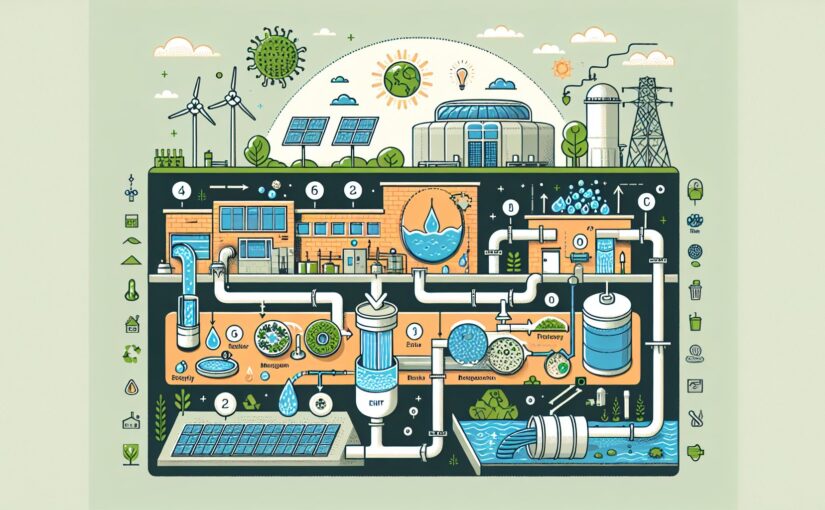
Wastewater is typically seen as a problem to be managed, but with the advent of new technologies, it can now be viewed as a resource. The concept of generating renewable energy from wastewater hinges on the ability to harness the chemical energy contained in the organic matter within the wastewater. Microbial Fuel Cells (MFCs) play a central role in this process, as they can convert organic matter directly into electrical energy with the help of microorganisms.
The Principle of Microbial Fuel Cells
Microbial fuel cells (MFCs) are bio-electrochemical systems that drive a current by mimicking bacterial interactions found in nature. MFCs consist of two compartments, or half-cells, separated by a proton exchange membrane. The anode compartment is where the wastewater is introduced, and it hosts microorganisms that consume the organic material, releasing electrons and protons. Electrons flow through an external circuit to the cathode, while protons travel through the proton exchange membrane. At the cathode, these electrons and protons typically combine with oxygen from the air to form water, thus completing the circuit. During this process, electricity is generated, which can be harnessed and used.
Why Renewable Energy from Wastewater?
The most compelling argument for using wastewater as a source of renewable energy is the twin benefit of treating wastewater and simultaneously generating energy. This not only reduces the energy footprint of wastewater treatment facilities but also contributes to reducing our reliance on fossil fuels. Furthermore, MFCs operate under ambient conditions, which means they do not require additional heating or aeration, leading to further energy savings.
Applications of Renewable Energy from Wastewater
Several applications for renewable energy generation from wastewater have been explored, ranging from small-scale designs for individual homes to large-scale systems for municipal wastewater treatment plants. These applications include:
- Power Generation: Although the power output from current MFCs is modest, they have the potential to supply energy for low-power needs within wastewater treatment plants or in remote locations.
- Biosensors: MFCs can serve as biosensors to detect pollutants or biochemical oxygen demand in wastewater streams.
- Bioremediation: MFCs can target specific contaminants, such as nitrogen or heavy metals, enhancing the treatment process and preventing environmental pollution.
- Desalination: Microbial desalination cells, a variation of MFCs, show promise in removing salts from saline waters while generating electricity.
Challenges and Opportunities
Despite their numerous benefits, several challenges must be overcome to make renewable energy from wastewater widely feasible:
- Scaling Up: The success of MFCs at the laboratory or pilot scale needs to be replicated on an industrial scale, which introduces challenges in maintaining efficiency and managing increased amounts of wastewater.
- Economic Viability: The cost of materials and construction, as well as long-term maintenance expenses, need to be reduced to make MFCs economically competitive with conventional technologies.
- Power Density: Current MFCs have low power densities, which means they require a large surface area to generate significant amounts of energy, thereby increasing the system’s size and cost.
- Electrode Materials: Finding affordable, efficient, and durable electrode materials is a priority to enhance the performance and longevity of MFCs.
The Future of Renewable Energy from Wastewater
Advances in MFC technology, such as the development of better electrode materials, improved designs for scalability, and increased public and private investment, could lead to the widespread adoption of renewable energy generation from wastewater. This sustainable approach could revolutionize wastewater treatment, minimize environmental impact, and contribute significantly to the global renewable energy portfolio.
Conclusion
Generating renewable energy from wastewater is an exciting and transformative technology that has the potential to redefine how societies manage wastewater. By embracing this innovation, we can move toward a future where wastewater treatment is not only sustainable but also a source of clean energy.
Sources
-
Logan, B. E., & Regan, J. M. (2006). Microbial Fuel Cells—Challenges and Applications. Environmental Science & Technology, 40(17), 5172–5180. https://pubs.acs.org/doi/abs/10.1021/es0627592
-
Pant, D., Van Bogaert, G., Diels, L., & Vanbroekhoven, K. (2010). A review of the substrates used in microbial fuel cells (MFCs) for sustainable energy production. Bioresource Technology, 101(6), 1533-1543. https://www.sciencedirect.com/science/article/abs/pii/S0960852409012257
-
Rabaey, K., & Rozendal, R. A. (2010). Microbial electrosynthesis — revisiting the electrical route for microbial production. Nature Reviews Microbiology, 8(10), 706–716. https://www.nature.com/articles/nrmicro2422
By implementing and investing in these innovative technologies, as well as addressing the current challenges, we can ensure a more sustainable and energy-efficient future for wastewater treatment.