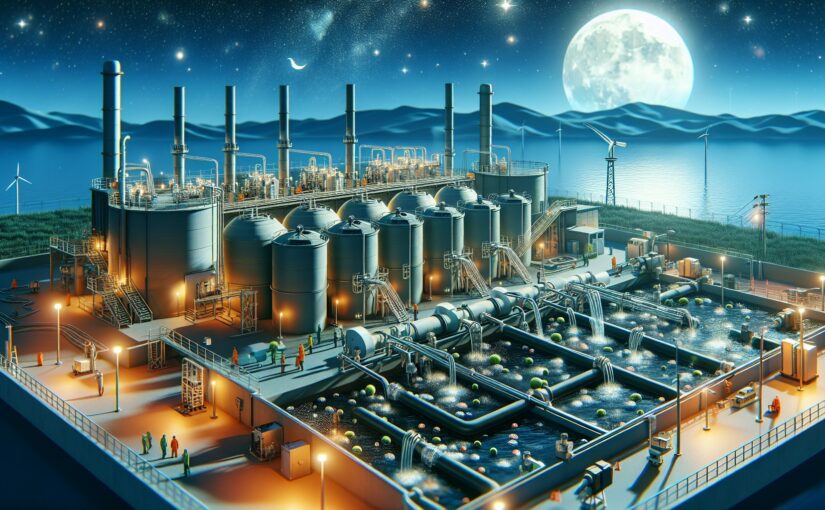
Harnessing the power of nature for clean, renewable energy is one of the great quests of our time. One of the frontiers in this vast domain is a process known as ‘bioelectricity generation’ – particularly, using wastewater. Yes, you read that right! Common wastewater can be a source of renewable energy. Bioelectricity generation from wastewater is not only an exciting renewable energy source but also a promising solution for wastewater treatment.
Journey to electricity
But how does wastewater generate electricity? Microorganisms are the key here. In the process of breaking down organic materials in wastewater, microorganisms also create electrons. Bioelectrochemical systems are designed to capture these electrons and generate electric current. This process is much like batteries, but instead of chemical reactions, microorganisms are responsible for electron production.
The role of microbial fuel cells
A microbial fuel cell (MFC) is a bio-electrochemical system that drives the electric current by using bacteria. Wastewater serves as the anode or the electron-donor side, and oxygen serves as the cathode or the electron-acceptor side. When these bacteria (in the anode) break down organic matter, they generate electrons. The separation of anode and cathode using a proton exchange membrane allows capturing this electron flow as electricity[^1^].
Advantages
Now, you may be wondering, why bother with this complex process? The advantages are manifold. First, it’s an environmentally friendly approach to wastewater treatment, reducing chemical usage and sludge production. Second, it’s a renewable energy source that helps us counter our reliance on fossil fuels. Finally, it’s an efficient way of dealing with organic waste; rather than being an environmental problem, waste is transformed into a valuable resource[^2^].
Opportunities and challenges
The field of bioelectricity generation from wastewater is burgeoning with opportunities but is not without challenges. The efficiency of current MFC technology, while improving, still needs to reach commercial viability. Research is ongoing to enhance power outputs and reduce costs.
Despite these challenges, the future is bright. If we can realize the full potential of this technology, we’ll open up a whole new chapter of renewable energy production, while providing efficient wastewater treatment[^3^].
Sources:
[^1^]: Logan, B.E., Rabaey, K., 2012. Conversion of Wastes into Bioelectricity and Chemicals by Using Microbial Electrochemical Technologies. Science (New York, N.Y.), 337(6095), pp.686–690.
[^2^]: Pant, D., Van Bogaert, G., Diels, L., Vanbroekhoven, K., 2010. A review of the substrates used in microbial fuel cells (MFCs) for sustainable energy production. Bioresource Technology, 101(6), pp.1533–1543.
[^3^]: Zhang, F., Tian, L., He, Z., 2015. Powering a wireless temperature sensor using sediment microbial fuel cells with vertical arrangement of electrodes. Journal of Power Sources, 278, pp.184–191.