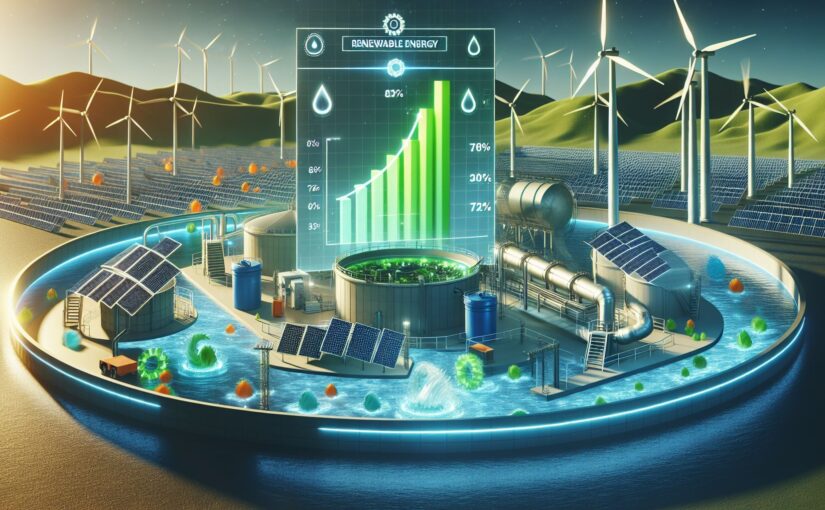
In an ever-evolving quest to create sustainable and efficient sources of energy, wastewater treatment and renewable energy generation have come to intersect with the development of an innovative technology known as microbial fuel cells (MFCs). At the crux of this intersection is the exciting capability to extract renewable energy from wastewater.
Introduction to Wastewater as a Resource
Globally, wastewater management remains a monumental challenge, often regarded as a burdensome task rather than an opportunity. However, altering our perspective on wastewater can set us on a path toward sustainability. Wastewater is not merely a substance to be disposed of but rather a potential source of energy, nutrients, and reusable water.
What is Wastewater?
Wastewater consists of water that has been affected by domestic, industrial, commercial or agricultural activities. It typically contains various organic and inorganic pollutants, as well as microorganisms. Traditionally, the main goal of wastewater treatment is to reduce these pollutants to acceptable levels before returning the water to the environment or repurposing it for other uses.
The Shift to Resource Recovery
The conventional linear economy of wastewater treatment, characterized by the “take-make-dispose” approach, is becoming increasingly unsustainable. In contrast, embracing the principles of a circular economy where reuse and resource recovery are emphasized aligns wastewater management practices with sustainability goals. This change in outlook brings us to the forefront of innovative possibilities, such as the generation of renewable energy from wastewater.
Microbial Fuel Cells (MFCs) for Wastewater Treatment
MFC technology stands out as a promising solution for renewable energy production from wastewater. MFCs are bioelectrochemical systems that harness the power of microorganisms to convert organic matter directly into electricity.
How MFCs Work
Electroactive Wastewater Bacteria: Within MFCs, certain kinds of bacteria, known as electrogenic or exoelectrogenic bacteria, can transfer electrons outside of their cell membranes during the decomposition of organic matter. These bacteria colonize an electrode known as the anode.
Bioanode and Biocathode: In an MFC, an anode serves as the site for bacterial colonization and oxidation of organic matter, while a cathode is where a reduction reaction occurs, completing the circuit. Together, the bioanode and biocathode form the core components of MFCs.
Proton Exchange Membrane: A proton exchange membrane (PEM) is often used to separate the anode and cathode chambers, permitting the flow of protons while preventing the migration of bacteria and oxygen, which could disrupt the anaerobic conditions required at the anode.
Electron Transfer Mechanisms: Electrons generated by the bacteria at the anode travel through an external circuit to reach the cathode. The transfer of electrons generates electricity, while the migration of protons across the PEM to the cathode chamber facilitates the reduction reactions necessary to complete the process.
Benefits of MFC Technology
MFCs promise several advantages over traditional wastewater treatment methods:
– Renewable Energy Production: Energy is gained as a by-product of the organic matter breakdown.
– Reduced Sludge Production: MFCs may result in less biosolid waste, reducing disposal costs.
– Low Energy Input: MFCs can operate under ambient temperatures and do not require aeration.
– Potential for Resource Recovery: Aside from energy, valuable by-products such as hydrogen gas and clean water can be obtained.
Challenges and Research
Though the potential of MFCs is significant, the technology faces hurdles like low power outputs, high costs of materials, and scaling issues. Research is ongoing to improve aspects such as electrode materials, reactor designs, and system efficiencies to make MFCs a commercially viable option for wastewater treatment and energy recovery.
Case Study: Renewable Energy from Wastewater
To illustrate the practical application and the potential of renewable energy generation from wastewater, let’s examine the case of a hypothetical wastewater treatment facility that has incorporated MFC technology.
The Facility
This facility, named “GreenFlow Energy,” incorporates multiple MFC units to treat high-strength organic wastewater from nearby food processing plants. The MFCs are complemented by a secondary treatment stage to ensure thorough organic matter degradation and compliance with environmental standards.
Processes and Outputs
At GreenFlow Energy, wastewater undergoes the following stages:
1. Pre-Treatment: Large solids and debris are removed.
2. MFC Treatment: Bacteria in the MFCs break down organic matter. Electrons generated are captured as electricity.
3. Secondary Treatment: Further treatment to remove any remaining pollutants.
4. Energy Generation: The electricity produced is either used on-site or fed back into the grid.
Performance Metrics
GreenFlow Energy reports the following:
– Power Density: Achieved competitive power densities of up to 1.5 W/m².
– Coulombic Efficiency: Averaged around 50%, indicating half the electrons generated are captured as electricity.
– Economic Efficiency: Reduced operational costs by 30% due to energy recovery and lowered sludge treatment expenses.
Scaling and Future Expansion
After proving successful at a smaller scale, GreenFlow Energy is looking into scaling-up its operations with stacked MFCs and continuous flow systems to increase capacity and power output. Research collaborations are looking at advanced electrode materials to further boost performance.
Conclusion: The Promise of a Renewable Future
Capturing renewable energy from wastewater through MFC technology aligns ecological responsibility with economic efficiency. While research and development are ongoing to address current limitations, the promise of a sustainable and renewable source of energy from a previously untapped resource is a goal worth pursuing.
Renewable energy from wastewater represents a leap towards a more sustainable future where waste turns into wealth, offering not just a solution for cleaner water, but a greener planet as well.
Sources
- Logan, B. E., & Regan, J. M. (2006). Electricity-producing bacterial communities in microbial fuel cells. Trends in Microbiology, 14(12), 512-518.
- Rabaey, K., & Verstraete, W. (2005). Microbial fuel cells: novel biotechnology for energy generation. Trends in Biotechnology, 23(6), 291-298.
- He, Z., & Mansfeld, F. (2009). Exploring the use of electrochemical impedance spectroscopy (EIS) in microbial fuel cell studies. Energy & Environmental Science, 2(2), 215-219.
Implementing this technology at a large scale, however, and integrating it smoothly into our current wastewater treatment infrastructures is a challenge that awaits novel solutions and continued research.